
Picture this: you’re standing on your Phoenix patio, the sun beating down, and you start wondering if all that heat could actually be working for you instead of just heating up your utility bill.
It’s a feeling many homeowners share – that mix of excitement about clean energy and the nagging doubt that a solar system might be too pricey, too complex, or just not worth the hassle in the desert heat.
Well, here’s what I mean: Phoenix gets more than 300 sunny days a year, which means a properly sized array can slash your electric bill by up to 80 % and even start paying you back through net‑metering credits.
And the good news? Local installers like Sean Whitmer make the whole process feel less like a mountain climb and more like a quick coffee chat – they handle permits, roof assessments, and the paperwork while you keep sipping your morning brew.
But you might be wondering, ‘Do I really need a battery, or can I just go grid‑tied?’ The answer isn’t one‑size‑fits‑all. If you love the idea of backup power for those rare summer storms, pairing panels with a solar battery gives you peace of mind. If you’re fine with the grid handling the occasional dip, a straightforward installation saves you money upfront.
Think about it this way: every kilowatt‑hour you generate is a tiny victory against rising rates, and each panel on your roof is a small investment that pays you back over the next 20‑25 years.
So, what’s the first step? Grab a free shade analysis from a local Phoenix installer. It takes just a few minutes, and you’ll walk away with a clear picture of how many panels you need, what orientation works best, and a ballpark cost that fits your budget.
Ready to turn that sun into savings? Let’s dive in and explore how a seamless Solar installation Phoenix can reshape your energy bills, boost your home’s value, and give you the freedom you’ve been craving.
TL;DR
A free shade analysis from a local Phoenix installer shows how many panels you need, the best roof orientation, and a ballpark cost, turning sun into savings.
Whether you choose a battery backup for storm resilience or a grid‑tied system, Solar installation Phoenix can slash bills by up to 80% and boost home value.
Assessing Solar Suitability in Phoenix
Alright, let’s take a step back and figure out whether your roof is actually ready for a solar upgrade. The desert can feel relentless, but that same sun is the secret sauce that makes a Phoenix solar system shine.
Sun angle, roof direction, and the magic number
First thing you’ll notice when you stand on the patio at noon: the sun is practically overhead. In Phoenix that means a south‑facing roof captures the most energy, while a west‑facing slope still pulls in plenty of late‑afternoon power. East‑facing sections are useful, but they’ll leave you with a bit less juice during the peak‑hour window.
What does “south‑facing” really mean? Think of a compass rose drawn on your roof. If the majority of your panel space points within 45 degrees of true south, you’re in the sweet spot. Anything beyond that, and you’ll start losing a few percent per degree—nothing catastrophic, but worth noting when you size your system.
Shade analysis: the hidden obstacle
Even the brightest city has shadows. A nearby oak, a lofty air‑conditioning unit, or even a decorative pergola can cast a sneaky silhouette over a panel. That’s why a free shade analysis from a local installer is worth the few minutes you spend on the phone.
During the analysis, the technician will use a sun‑path calculator to model how shadows move across your roof throughout the year. If a spot is shaded for more than 10‑15 % of daylight hours, they’ll either trim the obstruction or suggest a different array layout.
And here’s a quick sanity check: walk around your house at 10 a.m. on a sunny day. If you see a dark patch on the roof, that’s a red flag you’ll want to bring up with the installer.
Roof material and age
Most Phoenix homes have asphalt shingles, which play nicely with most mounting systems. Tile roofs are common too, but they require special brackets to avoid cracking the tiles. Metal roofs are actually a bonus—panels can be attached directly without penetrations, and the reflective surface helps keep the attic cooler.
If your roof is older than 15 years, consider a repair or a full replacement before you invest in solar. Panels last 25‑30 years, so you don’t want a roof that gives out halfway through the system’s life.
Electrical capacity and panel sizing
Older homes sometimes have a 100‑amp main panel, which can limit the size of a solar array. Upgrading to a 200‑amp panel isn’t cheap, but it opens the door to a larger, more future‑proof system—especially if you’re thinking about adding a battery later.
When the installer runs the numbers, they’ll compare your average monthly usage (you can find that on your utility bill) with the potential production from a given kW size. The goal is to hit a sweet spot where you offset most of your usage without over‑loading the grid connection.
Is your home’s orientation a deal‑breaker?
Short answer: almost never. Even a roof that’s 30 degrees off true south can still harvest enough sun to cut your bill dramatically, thanks to Phoenix’s high solar irradiance—roughly 6.5 kWh/m² per day on average.
What matters more is eliminating major shading and making sure the mounting system can handle the wind loads that occasionally sweep through the valley.
So, what’s the next concrete step? Grab that free shade analysis, ask the installer about roof age, and get a written estimate that includes the suggested panel layout.
If you’re also wrestling with indoor heat, you might find some unexpected inspiration from Hot Hungry and Healing, a site that talks about managing desert temperatures—sometimes the same principles apply to keeping your solar array cool and efficient.
Bottom line: Phoenix is practically begging for solar, but a quick sanity check on roof direction, shade, material, and electrical capacity will save you time, money, and a lot of head‑scratching later. Once those boxes are checked, you’re ready to move on to sizing your system and deciding whether a battery backup fits your lifestyle.
Choosing the Right Solar System for Phoenix Homes
Picture this: you’ve just watched the shade‑analysis video, you know your roof faces south, and you’re ready to pick the actual hardware that will turn that endless desert sun into savings. That moment feels a bit like choosing a new car – you want something that fits your daily drive, your budget, and maybe even a little room to grow.
Step 1: Size the system to your real‑world usage
Start with your monthly electric bill. In Phoenix the average homeowner needs roughly a 14 kW array to cover most consumption, which translates to about $2.06 per watt before incentives according to EnergySage data. If your bills average 900 kWh a month, a 7‑8 kW system will likely hit the sweet spot; if you’re an AC‑heavy family, bump that up to 10‑12 kW.
Don’t forget seasonal spikes. Summer cooling can push demand 30‑40 % higher, so oversizing by 10‑15 % gives you a buffer and keeps a future battery from draining too fast.
Step 2: Pick the panel technology that matches Phoenix glare
High‑efficiency monocrystalline panels (around 20‑22 % efficiency) squeeze more power into a smaller roof area – perfect if your roof is cramped or shaded by a pergola. If you have a sprawling roof with plenty of sun, slightly cheaper poly‑crystalline modules can still deliver solid output.
Real‑world example: the Martinez family in Ahwatukee installed 22 % efficient panels on a 1,800 sq ft roof and saw a 12 % increase in production compared to a neighbor who chose lower‑efficiency panels on the same roof footprint.
Step 3: Decide on inverter architecture
String inverters are the workhorse – fewer parts, lower upfront cost. Micro‑inverters or power‑optimizers, like Enphase IQ8, let each panel operate independently, which is a lifesaver if you have partial shading or plan to add panels later.
Tip from local installers: “If you think you might expand to an EV charger or a battery in the next few years, micro‑inverters make the upgrade painless,” says Sean Whitmer.
Step 4: Evaluate whether a battery makes sense now
If you’re comfortable relying on the grid for the occasional night‑time draw, a grid‑tied system saves the most money upfront. But if you want backup during the rare monsoon storm or plan to store excess solar for later use, a battery adds resilience.
Consider your lifestyle: a homeowner who works from home and runs a home office might benefit from a 10 kWh battery to avoid peak‑rate charges. An EV owner can pair a 12‑15 kWh battery with a Level 2 charger to charge at night with solar‑derived power.
Step 5: Crunch the numbers with local incentives
Arizona’s electricity rates have climbed about 19 % since 2021 Palmetto notes. That upward trend means every kilowatt‑hour you generate now is a hedge against future bills. Add the 30 % federal tax credit, the state’s 25 % credit (up to $1,000), and sales‑tax exemptions – the net price per watt can drop below $1.50 in many cases.
Don’t forget the “workmanship warranty” that reputable installers provide – usually 5‑10 years – and verify that the installer carries both a license and insurance.
Actionable checklist for your Phoenix solar decision
- Pull your last 12 months of bills; calculate average kWh.
- Use the 14 kW ≈ $2.06/W benchmark to estimate a ballpark system size.
- Choose high‑efficiency panels if roof space is limited.
- Prefer micro‑inverters if you anticipate future expansion.
- Decide now on a battery based on backup needs and EV plans.
- Ask the installer for a written warranty on both equipment and labor.
- Verify they have NABCEP certification or equivalent.
Real‑world tip: John, a Phoenix homeowner in Mesa, started with a 6 kW grid‑tied system in 2022. Two years later he added a 10 kWh battery and a Level 2 charger for his new electric SUV. His total savings topped $12,000, and he never worried about a power outage during the 2024 monsoon season.
Bottom line: the “right” system isn’t a one‑size‑fits‑all product; it’s the combination of size, panel type, inverter, and optional storage that aligns with your usage patterns, roof constraints, and future goals. Take the checklist, talk to a trusted local installer, and you’ll walk away with a solar solution that feels custom‑made for your Phoenix home.
Step-by-Step Solar Installation Process in Phoenix
So you’ve decided to go solar in Phoenix – congratulations! The excitement of watching your meter spin backwards is real, but the process can feel a bit like assembling IKEA furniture blindfolded. Let’s break it down into bite‑size steps so you know exactly what’s coming next and when you’ll start seeing those sweet savings.
Step 1: Quick site survey (1–2 days)
Within 24‑48 hours of signing the contract, our crew rolls up in a truck with a ladder, a drone, and a clipboard. We pop up on the roof, check the framing, take photos of the electrical panel, and measure the available space. If you’ve got a pergola, a chimney, or a tree that throws a shadow at 2 p.m., we note it now. The goal is to capture everything that could affect panel placement or performance.
During this visit you don’t need to be home unless we have to run a new breaker inside. Most homeowners just enjoy a coffee while we work – and you get a rough sketch of where the panels will sit.
Step 2: Engineering design & approval (1–2 weeks)
Our in‑house engineers take the survey data and run a sun‑path simulation that accounts for Phoenix’s scorching summers and monsoon winds. The design shows exactly how many kilowatts you’ll generate, the panel layout, and the type of inverter (string vs. micro‑inverter) that makes sense for your roof.
Once the blueprint is ready, we send you a clear, color‑coded plan for approval. If you spot something you’d like tweaked – maybe you want a little extra capacity for an upcoming EV – we adjust the design before moving forward.
Step 3: Permit acquisition (2–4 weeks)
Arizona municipalities are pretty efficient, but the paperwork still takes a moment. We file the building permit, the electrical permit, and any HOA paperwork if you live in a planned community. Our long‑standing relationships with the City of Phoenix permitting office usually shave a week off the clock.
While we’re waiting on approvals, you can start preparing the site: clear any stored items off the roof, trim low‑hanging branches, and let the neighbors know there might be a bit of noise on installation day.
Step 4: Physical installation (1–2 days)
When the permits are green‑lit, our certified installers arrive early to beat the afternoon heat. First, we mount the racking system – a steel frame that’s spaced to let hot air flow under the panels, which is crucial in a climate that often tops 115 °F.
Next, panels and micro‑inverters (or a string inverter, depending on your design) are bolted in place, conduit is run, and the system is wired to your main electrical panel. Most residential jobs are done in a single day, but a larger roof or a ground‑mount could stretch to two.
Step 5: Pre‑inspection testing
Before any city inspector shows up, we run a thorough power‑up test. This catches loose connections, verifies that each inverter is communicating, and makes sure the system meets the manufacturer’s performance specs. Think of it as a “dress rehearsal” before the big show.
Step 6: City & utility inspections (2–3 weeks)
We submit the test results and permit packets to the city building department and your utility (APS, SRP, or TEP). Inspectors verify that the installation complies with local codes and that the system is safely tied into the grid. In Phoenix, inspections typically clear on the first try because we double‑check everything beforehand.
After the city sign‑off, the utility schedules a net‑meter installation. That’s the device that lets you feed excess power back into the grid and earn credits.
Step 7: System activation & homeowner orientation
Once the new meter is in place, we flip the switch. You’ll see the inverter lights turn green and the monitoring app start streaming real‑time production data. We walk you through the app, show you how to read your daily generation, and explain how to set alerts for any performance drops.
That’s it! From contract to sunny savings, most Phoenix projects wrap up in 6–10 weeks.
Need a little extra guidance on next steps? Check out Solar Energy Installation in Phoenix, AZ & Texas for a deeper dive into financing options and warranty details.
And if you’re also thinking about buying a new home that’s ready for solar, you might find the real‑estate market insight at Fitumi Bako’s Gahanna, OH real‑estate page surprisingly useful – a solar‑ready home can boost resale value, after all.
Permits, Incentives, and Financing for Solar Installation Phoenix
Alright, you’ve got the roof ready and the panels sized – now it’s time to tackle the paperwork, the money‑saving programs, and the financing options that make solar installation Phoenix feel like a breeze instead of a bureaucratic nightmare.
Permits: What you actually need
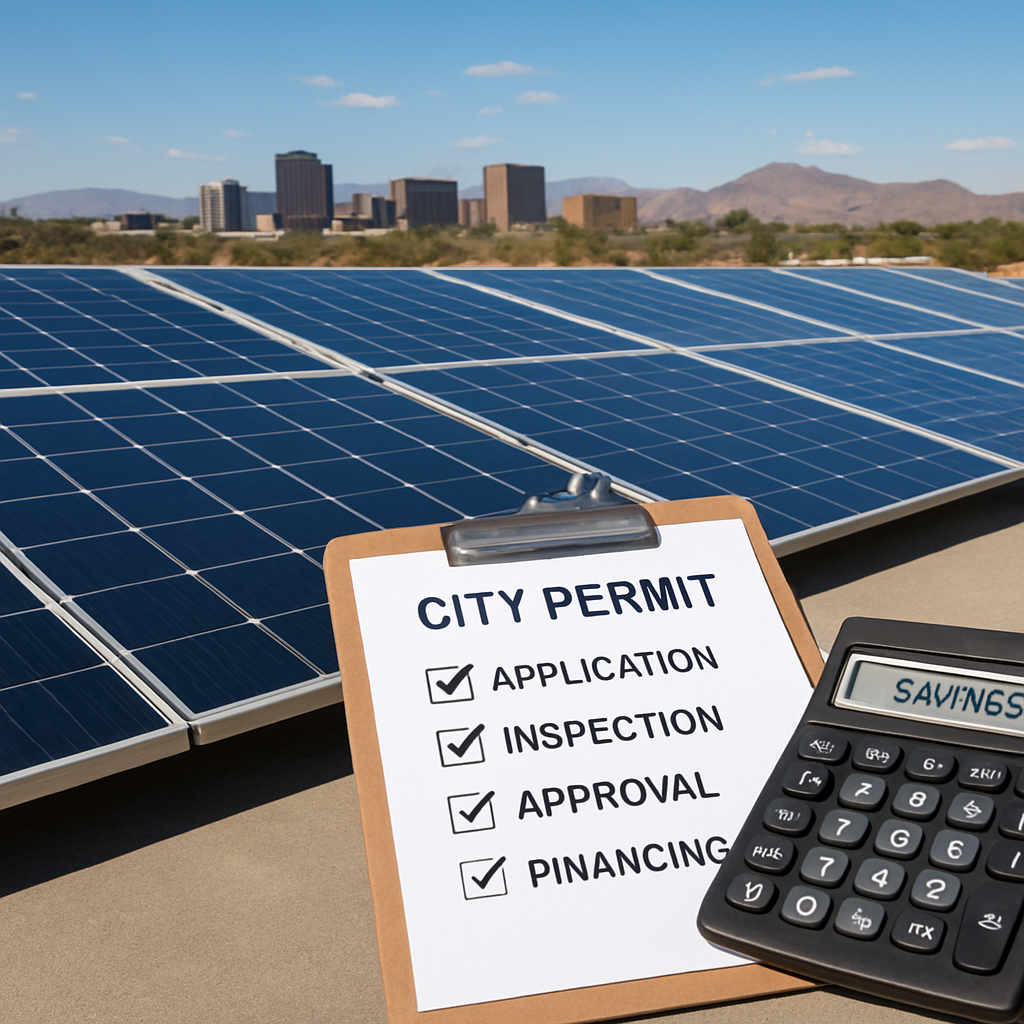
The City of Phoenix requires a building permit and an electrical permit for any residential PV system. You’ll also fill out a SolarAPP/Photovoltaic project form that outlines where the array will sit, how it’s grounded, and what inverter you’re using. Most installers, like Sean Whitmer’s crew, handle the forms for you, but you’ll still need to sign off on the final plans.
Once the plans are submitted, the city’s review team checks that the design complies with the local code – think fire safety distances, structural load limits, and proper wiring. In practice, inspections clear on the first try if you’ve double‑checked everything beforehand, which is why we always do a pre‑inspection test before the official visit.
Does this sound overwhelming? It doesn’t have to be. A quick call to the Phoenix Sustainability Department can give you the exact fee schedule and a checklist of required documents. The city’s solar energy page walks you through the permit steps and even points you to preferred installer resources.
Incentives: Let the city help you save
Phoenix offers a handful of rebates and incentives that can shave a solid chunk off your out‑of‑pocket cost. The most straightforward is the federal Investment Tax Credit (ITC), which currently covers 30% of the system price. On top of that, Arizona’s state credit can knock another 25% (up to $1,000) off the bill.
But the city itself also lists programs that bundle energy‑efficiency upgrades with solar. For example, the sustainability portal highlights rebates for solar‑ready homes and even ties in water‑conservation incentives for households that pair solar with low‑flow fixtures. Check the city’s incentives page for the latest offers, because new programs roll out regularly under the Bipartisan Infrastructure Law and the Inflation Reduction Act.
Tip: Ask your installer to pull a “incentive stack” – a quick spreadsheet that shows the ITC, state credit, and any local rebates side by side. It makes the total savings crystal clear and helps you decide whether to lease, finance, or buy outright.
Financing options: Making solar affordable
If you’re not ready to front the full cost, there are a few financing routes that keep cash flow healthy. Traditional loans (often 5‑ to 15‑year terms) let you own the system outright and claim the tax credits immediately. Home‑equity lines of credit can be cheaper, but they tie the loan to your property.
Many Phoenix residents also go for solar loans offered by local credit unions – they usually have lower interest rates than big‑bank options and sometimes bundle the loan with a battery purchase. Lastly, power‑purchase agreements (PPAs) let you pay a fixed rate for the electricity the system generates, which can be lower than your utility rate from day one.
Before you sign anything, run the numbers: calculate the levelized cost of electricity (LCOE) for each option and compare it to your current utility rate. If the LCOE is lower, you’ll start saving from the first month.
Quick reference table
| Item | Typical Options | Key Notes |
|---|---|---|
| Permits | Building + Electrical | Submit SolarAPP form; pre‑inspection saves time |
| Incentives | Federal ITC (30%), AZ State Credit (25% up to $1k), City rebates | Stack for max savings; check city portal for new programs |
| Financing | Bank loan, credit‑union loan, PPA, lease | Compare LCOE to utility rate; own system to claim credits |
So, what’s the next move? Grab a copy of the permit checklist, sit down with your installer, and ask them to draft an incentive‑stack spreadsheet. It’s the fastest way to see exactly how much you’ll pay versus how much you’ll save.
Once the paperwork’s signed and the rebates are locked in, you’ll be one step closer to watching that inverter light turn green and your meter spin backwards.
Maintenance and Performance Optimization for Phoenix Solar Systems
Let me be completely honest:
Keeping a solar system humming in Phoenix is not “set it and forget it.”
The heat, dust, and occasional monsoon grit demand a maintenance rhythm that protects performance and extends life.
So, what should you expect? Regular visual checks, monitoring, preventive cleaning, and a clear escalation plan for anything electrical.
Quick daily and weekly checks
Check your inverter or monitoring app every few days.
If production drops during sunny hours compared with recent baselines, flag it.
Walk the roof (safely, or have a pro) to spot cracked panels, loose clamps, or obvious shading changes like new tree growth.
Monthly and seasonal tasks
Dust and pollen build up fast in arid climates. During dust season plan for more frequent panel cleanings until rainfall returns.
Rinse panels with a hose or use a soft brush and mild detergent; avoid pressure washers and abrasive tools.
Look at wiring entries and conduit for rodent damage or UV‑brittle insulation.
Annual professional tune‑up (what to ask for)
Request a certified technician to:
Torque all mounts and electrical connections, verify grounding and rapid‑shutdown components, test string voltages and inverter efficiency, and inspect roof penetrations and flashing.
Ask them to upload a snapshot of inverter logs so you have a production baseline for the next year.
Using monitoring to catch problems early
You need a monitoring baseline. Once you have a few months of data, you can spot anomalies quickly.
Does your array produce significantly less than expected on similar sunny days? That’s a clear signal to investigate.
Set alerts for inverter faults, communication loss, and sustained underperformance — your app will often tell you before your bill does.
Batteries and backup systems
If your Solar installation Phoenix includes batteries, maintain them per manufacturer specs.
Keep firmware updated and check state‑of‑charge trends in the app.
If you notice capacity fading faster than expected, schedule a battery health check; loose connections or thermal stress can accelerate degradation.
Real‑world troubleshooting examples
A homeowner I worked with noticed midday dips in production. We found a loose micro‑inverter connector and a partial roof shading from a new satellite dish.
Tightening the connector and relocating the dish restored expected output.
Another neighbor avoided months of losses by adding periodic soft rinses through dust season instead of waiting for heavy monsoon rains.
Practical checklist you can use today
Follow this simple cadence to keep performance steady:
- Daily: glance at inverter lights and app summary.
- Weekly: review daily generation vs. the same day last month.
- Monthly: clean panels if dusty; trim obvious shade sources.
- Yearly: schedule professional inspection, torque check, and firmware updates.
So, what should you do next?
Grab your inverter app, pull a 3‑month production report, and flag any steady downward trend.
If you’re unsure, call a local NABCEP‑certified installer and ask for a performance audit.

For technical guidance and broader performance research, consult the U.S. Department of Energy’s resources on solar system performance: U.S. Department of Energy resources on solar system performance
Understanding Phoenix Solar Market Trends and ROI
When you look up at a Phoenix rooftop drenched in sunlight, it’s easy to feel the buzz of opportunity—but the real question is whether that buzz translates into a solid return on your investment.
What the market is doing right now
Arizona’s solar scene is heating up faster than the desert summer. Every March, the Solar + Wind Finance & Investment Summit pulls together the people who actually move money in this space, from banks to EPCs and investors. The summit’s agenda highlights how financing structures are evolving, and those changes are already trickling down to the average homeowner.
What does that mean for you? More flexible loan products, lower interest rates, and a growing appetite for “green” capital. In plain terms, the dollars you’d otherwise pay to a utility are now more accessible as low‑cost solar financing.
And it’s not just financing. The state’s net‑metering rules have tightened around compensation rates, but the market response has been an uptick in higher‑efficiency panels that squeeze more kilowatts out of the same roof square footage.
So, does the market hype actually help you? Absolutely—if you time your installation right and pick the right financial package.
Crunching the numbers: ROI basics
Let’s strip the math down to its bones. The basic payback formula is simple: initial cost divided by annual savings equals the payback period. EcoFlow walks through that exact calculation, and the numbers line up nicely for Phoenix.
Take a typical 7 kW residential system. Installation runs about $15,000 before incentives. The federal tax credit knocks 30 % off, and Arizona’s state credit trims another 25 % (up to $1,000). After those rebates, you’re looking at roughly $9,500 out‑of‑pocket.
If your system saves you $1,200 a year on electricity—thanks to over 300 sunny days—your break‑even point lands around eight years. That’s comfortably under the 25‑year life span most panels are built for, leaving you with a decade‑plus of profit.
Factors that can shift the ROI needle
Everything from panel efficiency to how aggressively you chase incentives can swing the payback period. Here are the biggest levers:
- Panel efficiency: High‑efficiency monocrystalline modules (20 %+) generate more power per square foot, meaning you need fewer panels and less mounting hardware.
- Financing choice: A low‑interest solar loan can front‑load the tax credit benefits, while a PPA spreads costs but may limit your upside.
- Utility rates: Phoenix’s electric rates have risen about 19 % since 2021, so each kilowatt‑hour you generate today is worth more tomorrow.
- Maintenance habits: Regular cleaning during dust season can shave 5‑10 % off your annual output loss.
Notice how each of those points ties back to the market trends we mentioned earlier. The newer financing products highlighted at the Infocast summit specifically address the “maintenance habit” concern by bundling service contracts with the loan.
Real‑world snapshot
Meet Maya, a Phoenix homeowner who installed a 6.5 kW system in early 2023. She used a 5‑year solar loan that incorporated a maintenance package negotiated after attending the 2025 summit. Within the first year she saw a 12 % boost in production after a simple panel rinse, and her loan’s interest rate was 2.1 % lower than the average local rate.
Fast forward two years, Maya’s system has already paid back more than 30 % of the total cost, and she’s on track to hit the eight‑year breakeven milestone. Her story underscores how market trends—especially financing flexibility and high‑efficiency hardware—can turn a good deal into a great one.
Quick checklist for maximizing ROI
Bottom line? Phoenix’s solar market is humming with financing creativity and tech upgrades, and those forces are pushing the ROI curve lower for homeowners. If you line up the right panel, the right loan, and a simple maintenance habit, you could be looking at a solid profit in under a decade.
Ready to see how those numbers play out for your roof? The next step is pulling a quick estimate—grab your last year’s electric bill, plug it into a solar calculator, and let the data do the talking.
FAQ
What does a typical Solar installation Phoenix timeline look like?
Most homeowners see the whole process wrap up in 6–10 weeks. First, you get a site survey (1‑2 days), then engineers draft a design (1‑2 weeks). Permits take another 2–4 weeks, followed by the actual roof‑mounting (1‑2 days). After a pre‑inspection, the city and utility sign off (2‑3 weeks), and finally the system is activated. Knowing each milestone helps you plan around work schedules and weather.
Do I need a structural engineer for my roof?
If your home is newer than 20 years or built with lightweight materials, a quick visual check for sagging or water stains can flag potential issues. Installers usually send an engineer for roofs older than 20 years or when the deck looks uncertain. The extra inspection costs a few hundred dollars but saves you from costly retrofits later, and it’s a standard part of a responsible Solar installation Phoenix.
Can I combine a solar loan with a battery purchase?
Absolutely. Many local credit unions offer bundled financing that lets you roll the battery cost into the same loan term. This keeps one monthly payment and lets you claim the federal tax credit on the whole system upfront. Just compare the interest rate on a pure solar loan versus a bundled loan—sometimes the bundled option carries a slightly higher rate, but the convenience often outweighs the small difference.
What maintenance does a Phoenix solar system actually need?
In the desert, dust is the biggest enemy. A quick hose‑down or soft brush cleaning once a month during the dry season can keep output up 5‑10 %. Besides cleaning, glance at the inverter lights weekly and check the monitoring app for any dip in production. Schedule a professional tune‑up once a year to torque mounts, verify grounding, and upload a fresh performance report.
How do net‑metering credits work in Phoenix?
When your panels generate more than you use, the excess flows back to the grid and your utility credits your account at the retail rate. Those credits roll over month‑to‑month and are applied to your next bill. In Arizona, the credit stays on your account for up to 12 months, so you’ll see a noticeable reduction in your annual electricity cost as long as you stay net‑metered.
Will a solar lease affect my home’s resale value?
Most buyers view a lease as a perk because it means lower monthly utility bills right away. However, the lease agreement usually transfers to the new owner, so the buyer needs to be comfortable with that contract. In practice, homes with a well‑maintained leased system often sell faster and for a modest premium, especially in sun‑rich markets like Phoenix.
What’s the best way to size my system for future electric‑vehicle charging?
Start by adding the EV’s estimated annual kWh use—about 3,500 kWh for a typical midsize electric car—to your current household usage. Then oversize the solar array by another 10‑15 % to give the battery buffer and account for seasonal spikes. A 9‑10 kW system usually covers a family that drives a daily commuter EV while still leaving room for air‑conditioning peaks.
Conclusion
You’ve made it through the checklist, the design options, the permits, and the maintenance plan – so what’s the bottom line for Solar installation Phoenix?
In short, the desert sun is a cheap, reliable partner when you pair the right system size with high‑efficiency panels and a future‑proof inverter. That combo lets you shave a good chunk off your electric bill from day one, and the credits from net‑metering keep the savings rolling for at least a year.
But it isn’t just about dollars. It’s the peace of mind that comes from knowing your home can stay powered during a monsoon storm or a grid hiccup, especially if you added a battery for backup.
So, what should you do next? Grab your latest utility bill, run a quick solar calculator, and schedule that free shade analysis we mentioned earlier. A 15‑minute call with a local installer can turn those numbers into a concrete proposal.
Remember, Solar installation Phoenix isn’t a one‑size‑fits‑all project. It’s a conversation between your roof, your lifestyle, and the relentless Arizona sun. Walk into that meeting with confidence, ask the right questions, and you’ll walk out with a system that feels custom‑made for you.
Ready to lock in today’s incentives and start saving? Reach out to Sean Whitmer’s team and let the sunshine work for you.