
You’ve probably stared at a solar quote and felt that knot in your stomach, wondering if the price tag is worth the sunshine.
And yet, every summer evening you watch the sun dip behind the desert horizon, thinking about those rising electric bills that never seem to stop climbing. Does the “Cost of solar panel installation” really have to feel like a mystery?
In our experience at Pep Energy, the first thing homeowners and business owners alike discover is that the headline number is only part of the story. There are three big buckets: equipment, labor, and “soft” costs like permits and interconnection fees. When you break it down, the math starts to look a lot less intimidating.
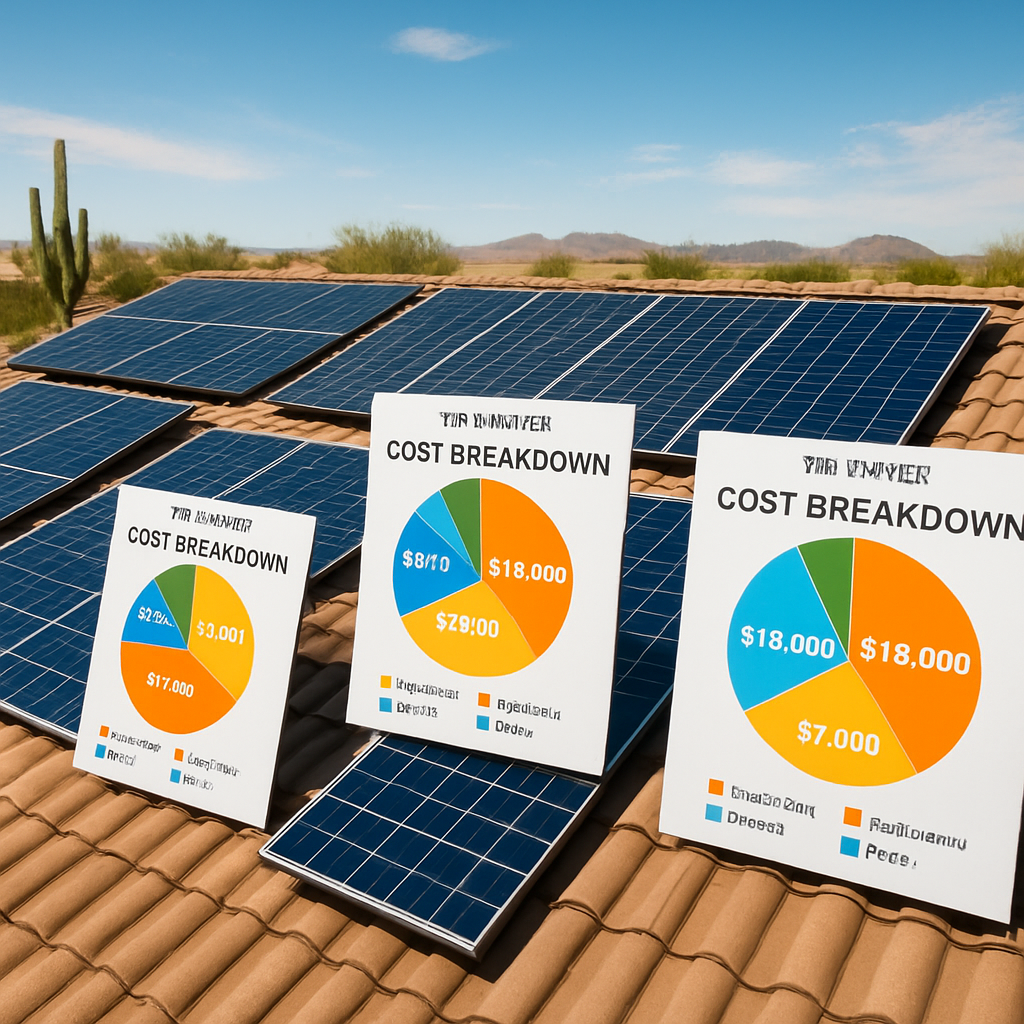
Imagine you’re a family in Phoenix deciding whether to swap out a 6‑kW system. The panels themselves might run you about $12,000, the roof work and wiring another $4,000, and the paperwork—permits, inspections, utility fees—adds roughly $1,500. Suddenly the total sits near $17,500, not the $30,000 you imagined from a quick Google search.
But here’s the kicker: those numbers shift based on the type of financing you choose. A cash purchase locks in the full cost up front, while a solar lease spreads a smaller monthly payment over 20 years, and a loan lets you keep cash in hand and claim tax credits. So the “cost” you focus on can be the upfront outlay, the monthly cash flow, or the long‑term return on investment.
Does that help clear the fog? If you’re still unsure, ask yourself: how much are you paying today for electricity, and how fast do you want to see savings show up on your bank statement? That simple question often points you toward the financing path that aligns with your budget.
Let’s dive deeper into each cost component, explore real‑world examples, and give you a checklist to calculate your own numbers. By the end, you’ll feel confident that the cost of solar panel installation is a decision you can own—not a mystery you have to live with.
TL;DR
The cost of solar panel installation breaks down into equipment, labor, and soft costs, and varies dramatically depending on financing—cash, loan, or lease—so you can match the option to your budget and timeline. By using our simple checklist, you’ll instantly see how much you’ll actually spend, what savings to expect, and which financing path makes the most sense for your home or business.
Understanding the Factors That Influence Installation Costs
When you start digging into the cost of solar panel installation, the first thing that pops up is a long list of line‑items that feel more like a grocery receipt than a simple price tag. And that’s because every project is a little puzzle made of equipment, labor, permits, and a handful of hidden variables.
Let’s break it down. The panels themselves – the cells, the glass, the frame – are the biggest chunk. But even within that category you’ll see price swings based on efficiency, brand reputation, and warranty length. A high‑efficiency monocrystalline panel might cost $2.50 per watt, while a cheaper polycrystalline option could be $1.80 per watt. That difference adds up fast on a 7‑kW system.
Next up is labor. Installation isn’t just slapping panels on a roof. It includes structural assessments, mounting hardware, wiring, and the final connection to the inverter. Roof pitch, material (shingle vs. tile), and the height of your home can turn a straightforward job into a day‑long marathon. In Phoenix, a typical labor charge runs $1.20–$1.80 per watt, but if you have a flat roof with a ballasted racking system, expect the higher end.
Permits and interconnection fees are the “soft” costs that catch people off guard. Your local utility might charge a $300‑$500 interconnection fee, and the city could require a $200 permit. These aren’t optional, but they’re often omitted from the headline quote.
Now, here’s a factor that isn’t physical at all: financing. Whether you pay cash, take a loan, or opt for a lease dramatically reshapes the cash flow. In our experience, homeowners who choose a solar loan see a lower upfront price but need to factor interest over 10‑15 years. Those who lease enjoy predictable monthly payments but may miss out on tax credits. If you’re curious about the financing landscape in Arizona, check out our Solar Financing Options in Arizona guide for a quick rundown.
Location matters, too. Sun‑rich zones like the Sonoran Desert give you higher production per panel, which can shrink the overall system size you need. Conversely, shading from nearby trees or an adjacent building can force you to buy more panels to hit the same energy target, nudging the cost up.
Don’t forget the battery. Adding storage to your system adds roughly $1,000‑$1,500 per kilowatt‑hour, plus extra inverters and control gear. It’s a smart move if you want to ride out peak‑rate hours, but it’s a cost you need to plan for early.
And if you drive an electric vehicle, think about how your solar system will power it. A handy resource for EV owners is Selene – an AI‑powered EV assistant that helps you match your home’s solar output to charging needs.
Below is a quick visual recap of the main cost drivers.
Take a moment to watch – the video walks through a typical Phoenix installation, pointing out where those hidden fees hide.

Bottom line: the cost of solar panel installation isn’t a single number. It’s a blend of hardware choices, labor complexities, local regulations, and financing strategy. By mapping each factor to your specific situation, you can turn that intimidating quote into a clear, actionable plan.
How to Calculate Your Solar Panel Installation Cost
Feeling a little lost when the installer hands you a lump sum? You’re not alone—most homeowners stare at a single number and wonder what’s really inside it.
The good news is that you can break the Cost of solar panel installation down into four predictable buckets: equipment, labor, soft costs, and incentives. When you map each bucket to a line on your quote, the mystery disappears.
Step 1: List every piece of equipment
First, write down every piece of hardware you’ll actually see on the roof or in the garage. Solar panels, inverter, mounting racking, and the monitoring kit are the core items. Add any optional add‑ons like a battery storage module or a solar‑ready EV charger.
For a typical 6 kW Phoenix home, panels might run $12,000, inverters $1,800, racking $1,200, and monitoring hardware $600. Add those numbers together and you have your equipment subtotal.
Step 2: Estimate labor
Labor is the smallest slice of the Cost of solar panel installation, but it still matters. According to the National Renewable Energy Lab data, labor typically accounts for about 5.5 % of the total project price — roughly 16 cents per watt for a residential system. That means a $25,000 quote translates to roughly $1,375 in installation labor. The same source breaks down the average wages by region, so Arizona’s labor cost will sit near the national average.
Seeing the numbers in action helps. Below is a quick walkthrough that shows how a contractor tallies each line item.
Now that you’ve visualized the process, remember labor usually stays under 6 % of the total. If your quote is $25,000, expect about $1,350 for installation work, which aligns with the NREL benchmark we just discussed.
Step 3: Add soft‑cost items
Soft costs are everything that isn’t hardware or labor. Permits, inspection fees, interconnection charges, and any required electrical upgrades fall here. In Maricopa County a basic building permit is $250, while the utility may ask for $600 to connect your system to the grid.
Example: A homeowner in Scottsdale needed a 200‑amp service upgrade costing $2,200 and a roof‑reinforcement kit for $850. Those two soft‑cost items add $3,050 to the project, which is roughly 12 % of a $25,000 install.
Step 4: Apply incentives
Finally, subtract the incentives you qualify for. The federal solar Investment Tax Credit still offers a 30 % credit, and Arizona’s state rebate can add up to $1,000 per kilowatt. On a 6 kW system that’s $1,800 from the state plus $5,400 federal credit, knocking $7,200 off the gross price.
Pull everything into a simple spreadsheet: column A – line‑item description, column B – cost before incentives, column C – incentive amount, column D – net cost. Total column B, subtract total column C, and column D shows the net Cost of solar panel installation you’ll actually pay.
Quick checklist before you sign: • Ask for an itemized quote that separates equipment, labor, and soft costs. • Verify roof condition and any needed electrical upgrades. • Confirm all permit and interconnection fees are listed. • Calculate the net cost after the 30 % federal credit and any Arizona rebate. • Compare cash purchase versus loan or lease cash‑flow to see which fits your budget. Doing this homework turns a vague number into a clear roadmap toward energy independence.
Average Cost Breakdown by System Size
When you start looking at quotes, the first thing you notice is that the total price jumps up or down depending on how many kilowatts you’re planning. That’s the reality behind the Cost of solar panel installation – it’s not a one‑size‑fits‑all number.
Small residential systems (3 kW – 4 kW)
Think of a modest starter system that powers a few lights, a fridge, and maybe an EV charger for a single‑car household. In Arizona, a 3 kW install typically runs between $8,500 and $10,500 before incentives. That works out to roughly $2.80‑$3.00 per watt. One of our recent clients in Glendale chose a 3.5 kW kit; the equipment alone was $9,800, labor added $1,200, and soft costs (permits, interconnection) were $950. After the 30 % federal tax credit and a $1,000 state rebate, the net out‑of‑pocket hit $5,800.
Mid‑range homes (5 kW)
According to average 5 kW system cost data for 2025, a typical 5 kW residential system is about $13,550 before any incentives. That’s roughly $2.71 per watt, a sweet spot for many Phoenix families. Take the Ramirez family: their 5 kW design broke down to $11,200 for panels and inverter, $1,400 for mounting and labor, and $1,500 for permits and inspection fees. Subtracting $4,065 federal credit and $5,000 state rebate left them with a $4,035 net price – a figure that paid for itself in under six years.
Larger residential or small‑business systems (8 kW – 10 kW)
When you bump up to an 8 kW or 10 kW array, the per‑watt price drops because bulk equipment and labor economies kick in. A recent 9 kW commercial‑grade install in Tucson cost $22,000 total, or $2.44 per watt. The breakdown looked like this: $16,200 equipment, $2,700 labor, $3,100 soft costs. After the same federal credit (30 %) and a $9,000 state rebate, the net bill was $7,860. The larger system also slashed the homeowner’s electric bill by about $2,200 a year.
So why does size matter so much? The Department of Energy’s PV system cost benchmarks show that fixed‑mount structures and permitting fees stay relatively flat, while the hardware cost scales with capacity. In plain English: you pay a similar amount for a roof permit whether you install 3 kW or 10 kW, but you get more panels for the same permit fee.
Here’s a quick checklist you can run while you’re reviewing quotes:
- Write down the system size (kW) and calculate the $/W by dividing the total hardware cost by the rated capacity.
- Separate labor from equipment – labor should stay under 7 % of the total.
- Identify every soft‑cost line item (permits, interconnection, utility fees) and add them up.
- Apply the 30 % federal ITC and any Arizona state rebate you qualify for.
- Calculate the net cost per watt after incentives – lower numbers mean a better deal.
Real‑world tip: ask the installer to give you the cost per watt for each size option side‑by‑side. That simple number instantly tells you whether you’re paying a premium for a smaller system or getting a bulk discount on a larger one.
Another thing to watch is the “sweet spot” for your roof’s available space. One homeowner in Mesa had a roof that could fit up to 7 kW, but they chose 5 kW because the extra two kilowatts would have required a costly structural reinforcement – an extra $2,200 in soft costs that erased any per‑watt savings.
Bottom line: start with the system size that matches your energy use, then drill down into the cost breakdown. The numbers will reveal whether you’re getting a good value or just a higher‑priced, smaller array.
Comparing Costs: Buying vs Leasing Solar Panels
When you start looking at the Cost of solar panel installation, the first fork in the road is usually: do you own the system or rent it? That decision feels huge because it changes every line on your quote.
Think about it like this: buying is a marathon—you pay a bigger chunk up front (or take out a loan) and you keep all the finish‑line benefits. Leasing is more like a sprint: you walk in with almost no cash outlay, but you keep paying a monthly “rent” for as long as the contract runs.
Upfront cash vs. monthly budget
If you have savings or can secure a low‑interest loan, a cash purchase can lock in the full hardware cost—say $15,000 for a 5 kW system in Phoenix—minus the 30% federal tax credit. Your first‑year out‑of‑pocket might be $10,500, and then the bill drops to almost zero (aside from a tiny maintenance fee).
Leasing, on the other hand, typically starts with $0 down. You might see a monthly payment of $90‑$120 for the same 5 kW array. That amount includes installation, monitoring, and maintenance, but it never goes away unless you buy out the lease.
Tax credit ownership
Owning means you claim the 30% Investment Tax Credit (ITC) before it expires at the end of 2025. For a $15,000 system that’s a $4,500 reduction—something a homeowner can’t get when they lease. The leasing company pockets that credit and may pass some of the savings into a lower monthly rate, but you don’t see the full benefit.
That nuance is why the detailed pros and cons of leasing vs buying solar panels often highlight tax credit ownership as the biggest differentiator.
Long‑term savings vs. predictable payments
Owners typically hit a payback period of 7‑10 years, after which every kilowatt‑hour you generate is essentially free. Over a 25‑year lifespan, that can translate into $15,000‑$20,000 saved on electricity.
Leasers enjoy a steady reduction in their utility bill, but because they keep paying the lease, their net savings plateau. In many cases, total savings over 20 years end up 30‑40% lower than what an owner would see.
Resale value and flexibility
Having solar on your roof can boost your home’s market value—often $10,000‑$15,000 in Arizona neighborhoods. A lease can complicate a sale; you either have to transfer the agreement (which scares some buyers) or buy out the remainder, adding an unexpected cost at closing.
For businesses, the calculus shifts. A commercial lease can preserve cash flow and free up capital for other projects, while buying may qualify for accelerated depreciation, further improving the bottom line.
Actionable checklist
- Calculate your total upfront cost after the 30% ITC if you buy.
- Ask the installer for the exact monthly lease amount, including any escalator clauses.
- Run a 20‑year cash‑flow model: compare total payments (upfront + loan interest) vs. total lease payments.
- Check how the option affects your home’s resale value or your business’s balance sheet.
Bottom line: if you can afford the initial spend and want maximum savings, buying wins. If cash flow is tight and you prefer a hands‑off experience, leasing can still make sense—just be aware you’re trading long‑term profit for short‑term convenience.
| Aspect | Buying | Leasing |
|---|---|---|
| Upfront cost | High (cash or loan) | None or minimal |
| Tax credit | Owner claims 30% ITC | Company claims credit |
| Long‑term savings | Maximum after payback (≈$15‑$20k over 25 yr) | Reduced, fixed monthly fee |
| Home resale impact | Adds $10‑$15k value | May complicate sale |
Ways to Reduce Your Solar Installation Expenses
Ever stare at the line‑item “Cost of solar panel installation” and think, “There’s gotta be a way to shave a few thousand off this?” You’re not the only one – we’ve heard that sigh a dozen times at Pep Energy.
Start by getting three or four quotes and ask each installer to break the total into equipment, labor and soft costs. When you compare the $/watt, a modest difference in labor rates or a discount on mounting hardware can trim $300‑$500 per kilowatt on a $20,000 project.
Next, look at the panel type you really need. Monocrystalline panels deliver the highest efficiency, but in sunny Arizona a quality poly‑crystalline set often produces the same output for $0.20‑$0.30 per watt less. If you have ample roof space, the cheaper option won’t hurt your savings.
Third, let the roof dictate the layout. A simple south‑facing slab lets the crew bolt racking straight on; a roof with dormers, skylights or a steep pitch adds custom brackets and extra labor. In our experience a quick roof audit before you sign can reveal whether trimming a few branches or moving a vent could save $1,000‑$1,500 in mounting costs.
Don’t forget the incentives that already exist. The federal Investment Tax Credit still covers 30 % of the net price, and Arizona’s state rebate can knock another $1,000 per kilowatt off the bill. Run the numbers in a spreadsheet – the “final” price often ends up 40‑45 % lower than the headline quote.
Explore financing that matches your cash flow. A low‑interest solar loan lets you claim the tax credit immediately while spreading payments over 10‑15 years. If you prefer predictability, a solar lease with a modest escalator can still be cheaper than paying full price up front, especially when you pair it with a modest battery that shifts load to off‑peak hours.
Adding a small battery storage system can reduce the amount of energy you need to buy from the grid during peak‑price months, effectively lowering the “net” cost of the installation over its life.
Timing matters, too. Many utilities release extra rebates in the first quarter, and installers often discount projects during the slower winter months. Planning your install for November through February can net you both a better price and a faster return on investment.
Here’s a quick checklist you can run right now:
- Get at least three itemized quotes and calculate $/watt.
- Ask which panel type is best for your roof’s orientation.
- Schedule a free roof audit to spot unnecessary mounting work.
- Apply the 30 % federal ITC and any Arizona state rebates.
- Compare loan, cash, and lease cash‑flow models.
- Evaluate if a small battery would lower your monthly grid bill.
- Target off‑peak months for installation to capture extra discounts.
Bottom line: the “Cost of solar panel installation” isn’t set in stone. By digging into each line item, leveraging incentives, and timing the project wisely, you can bring the price down enough that the savings start showing up on your utility bill within the first couple of years.
FAQ
What factors actually drive the Cost of solar panel installation?
It isn’t just the price tag on the panels. You’ll see three big buckets: equipment (panels, inverter, mounting, monitoring), labor (the crew that gets everything on the roof), and soft costs like permits, inspection fees, and utility interconnection charges. On top of that, location‑specific incentives and any needed electrical upgrades can swing the total up or down by a few thousand dollars.
How much does a typical residential solar system cost in Arizona?
For a 5‑kW system, which covers most Phoenix homes, you’re looking at roughly $13,500 before incentives. Break that down and you get about $2.70 per watt for equipment, plus 5‑6 % for labor, and another 5‑10 % for soft costs. After the 30 % federal tax credit and a possible state rebate, the net out‑of‑pocket can drop to around $4,000‑$5,000.
Can I lower the Cost of solar panel installation by choosing different panel types?
Absolutely. Monocrystalline panels deliver the highest efficiency but carry a premium—usually $0.20‑$0.30 more per watt. Poly‑crystalline or newer bifacial options can shave that cost while still producing plenty of power in Arizona’s sun. If your roof has plenty of space, opting for a slightly lower‑efficiency panel often reduces the total bill without hurting your long‑term savings.
Do permits and other soft costs really add up?
They can feel like a surprise if they’re not itemized upfront. In Maricopa County a basic building permit is about $250, while interconnection fees can range from $400‑$600. Electrical upgrades—like moving from a 100 A to a 200 A service—might add $2,000‑$3,000. All together, soft costs typically represent 5‑10 % of the overall project, so budgeting for them early prevents nasty line‑item bumps.
How does financing affect the overall Cost of solar panel installation?
Financing changes the cash flow, not the raw numbers. A cash purchase lets you claim the 30 % ITC immediately, slashing the net price. A low‑interest solar loan spreads that net cost over 10‑15 years while you still reap the tax credit. Leasing eliminates upfront outlay, but the leasing company keeps the credit and you end up paying a higher monthly rate for the life of the lease.
Is it worth adding a battery to reduce the Cost of solar panel installation?
Adding a modest battery can lower your monthly grid bill by shifting usage to off‑peak hours, especially if your utility has demand‑charge spikes. The battery itself adds $3,000‑$5,000 to the upfront cost, but the combined system often qualifies for additional incentives and can improve the overall payback period. For homeowners who want more resilience, the extra expense often pays for itself within five to seven years.
What timing tricks can help me save on installation?
Seasonality matters. Installers frequently offer discounts during the slower winter months—think November through February—when demand dips. Many utilities also roll out extra rebates in the first quarter of the year. By syncing your project to these windows, you can capture both installer discounts and additional incentive dollars, shaving a few thousand off the headline Cost of solar panel installation.
Conclusion
After walking through equipment, labor, soft costs and incentives, the Cost of solar panel installation suddenly feels like a set of levers you can move, not a mysterious number.
We’ve seen homeowners in Phoenix shave $3,000 by timing their install for the winter slowdown, and business owners trim another few thousand by choosing poly‑crystalline panels that still meet their production goals. Those real‑world tweaks add up, turning a daunting price tag into a manageable plan.
So, what’s the next step? Grab an itemized quote, flag every $/watt line, and run the numbers through a simple spreadsheet – equipment, labor, soft costs, then subtract the 30 % federal ITC and any Arizona rebates. If the net cost still looks high, ask us about low‑interest solar loans or a lease that matches your cash flow.
Remember, the biggest savings come from the details you control: roof simplicity, panel choice, and timing. By tweaking those, you can often bring the net Cost of solar panel installation down enough that the payback period shortens to under six years.
Ready to take the guesswork out of your budget? Reach out, and we’ll help you map a path that fits your home or business – no pressure, just a clear picture of what you’ll actually spend and save.