Picture this: you’ve just installed a rooftop solar array on your Phoenix home, and the sun’s been generous all day. When the panels start feeding electricity back into the grid, you hear the term “buyback rate” tossed around, and you wonder—how much are you actually getting paid?
That feeling of uncertainty is common. The SRP solar buyback rate is the price the utility credits you for each kilowatt‑hour (kWh) it pulls from your system. It’s not a static number; it shifts with market conditions, seasonal demand, and the specific rate plan you’re on. For many residential homeowners, the rate hovers around 2 to 3 cents per kWh, but during peak summer months it can climb higher, especially if you’re enrolled in SRP’s Net‑Metering program.
Why does this matter? Because that credit directly offsets your electric bill. Imagine you generate 800 kWh in a month, and SRP buys back 200 kWh at 2.5 cents—that’s a $5 saving right there. Over a year, those credits add up, shaving off a noticeable chunk of the utility’s charge and improving your overall return on investment.
In our experience working with both residential homeowners and small business owners, we’ve seen a few patterns. First, customers who pair solar with a battery tend to capture more self‑consumption, reducing the amount they need to sell back at the lower buyback rate. Second, timing your system’s production to coincide with SRP’s higher‑rate periods—like late afternoon when air‑conditioning spikes—can boost credits.
If you’re still fuzzy on how SRP structures its various plans, our guide Understanding the SRP Solar Rate Plan: A Complete Guide for Homeowners breaks down the options, eligibility criteria, and billing nuances in plain language.
Here are three quick steps you can take today to maximize the buyback benefit: 1️⃣ Check your current SRP rate plan in the online portal and note the listed buyback price. 2️⃣ Review your solar production data (most inverters have an app) to see how much you’re actually exporting versus using on‑site. 3️⃣ Consider adding a modest‑size battery or adjusting your consumption habits—run the dishwasher or pool pump during peak solar hours to keep more energy home.
A real‑world example: the Martinez family in Scottsdale installed a 6 kW system last summer. By monitoring their export, they discovered they were sending 150 kWh back at a 2 cent rate. After adding a 5 kWh battery, they cut export by half and saw their net‑metering credits rise to 3.2 cents per kWh, translating into an extra $60 in savings annually.
Bottom line: the SRP solar buyback rate isn’t a mystery you have to live with blindly. By staying informed, tracking your data, and fine‑tuning consumption, you can turn those credits into a meaningful boost to your bottom line. Ready to dig deeper? Let’s explore the next steps together.
TL;DR
The SRP solar buyback rate determines how much you get paid for excess power, typically 2‑3 cents per kWh, and understanding it can shave dollars off your Arizona electric bill. By checking your plan, monitoring export data, and using a modest battery, you can boost self‑consumption and turn those credits into real savings.
Understanding SRP Solar Buyback Rate Basics
When your panels start feeding electricity back into the grid, the first thing you hear is the term “buyback rate.” It’s basically the price SR P credits you for every kilowatt‑hour (kWh) it pulls from your system. That number might look tiny—often just two to three cents—but over months and years it can shave a noticeable chunk off your bill.
Why does the rate change? SR P sets it based on wholesale market prices, seasonal demand, and the specific rate plan you’re on. During the scorching summer in Phoenix, when everyone’s cranking the A/C, the wholesale price spikes, and you’ll see the buyback creep upward. In the milder winter months the rate can dip back down.
The good news? You don’t have to sit passively and hope for a better rate. By understanding the mechanics, you can time your consumption, add storage, or even tweak your system size to capture more value.
How the Rate Is Calculated
SR P takes the total kWh you export in a billing cycle, multiplies it by the applicable buyback price, and posts that as a credit on your statement. For example, if you exported 150 kWh at 2.5 cents per kWh, you’d see a $3.75 credit. It looks small, but combine it with the savings from using the solar you generate on‑site, and the total impact grows.
One subtle detail many homeowners miss is the “time‑of‑use” (TOU) adjustment. Some SR P plans award a higher rate for exports that occur during peak demand windows (usually late afternoon). If your inverter’s export data shows a spike after 3 p.m., that’s the sweet spot you want to target.
Factors That Influence Your Buyback Rate
Here’s what typically moves the needle:
- Wholesale market volatility – prices rise when the grid is strained.
- Seasonal demand – summer heat drives higher rates.
- Rate‑plan tier – net‑metering vs. export‑only plans have different credit structures.
- Time‑of‑use windows – exporting during peak hours can boost the credit.
For residential customers, the most common plan is SR P’s Net‑Metering, which caps the buyback at the avoided cost rate. Business owners on a commercial rate may see a slightly higher credit, but the principle stays the same.
If you’re visual‑learner, the short video below walks through a real bill example, showing exactly where the buyback credit lands.
Take a moment to watch it, then keep reading for practical steps you can apply right now.
Now that you see the numbers, let’s talk tactics you can use today to squeeze a bit more out of that credit.
1️⃣ Monitor your export data daily. Most modern inverters have a companion app that tells you exactly how many kWh you’re sending out each hour. Spot the peak‑export windows and note the rate SR P is applying.
2️⃣ Shift discretionary loads to match those windows. Running the dishwasher, washing machine, or pool pump between 2 p.m. and 5 p.m. can keep that energy on‑site, reducing the amount you have to sell at the lower rate.
3️⃣ Consider a modest battery. Even a 4‑5 kWh unit can store excess midday production and discharge it during the late‑afternoon peak, turning a low‑rate export into a higher‑value self‑consumption event.
4️⃣ Review your rate plan annually. SR P occasionally updates its TOU periods or introduces new export‑only options. A quick check in the customer portal can reveal a better plan that bumps the credit from 2.4 cents to 3.0 cents per kWh.
5️⃣ Stay informed about policy changes. Arizona’s Public Utility Commission sometimes adjusts the avoided‑cost methodology, which directly impacts the buyback. Signing up for the utility’s newsletter or following local solar forums keeps you in the loop.
Bottom line: the SR P solar buyback rate isn’t a static, mysterious number. It’s a moving target that reacts to market forces, seasonal demand, and the plan you choose. By tracking your export, timing your loads, and adding storage when it makes sense, you can turn those modest credits into a meaningful boost to your bottom line.
How SRP Calculates Your Solar Buyback Rate
Ever looked at your SRP bill and wondered why the credit for exported solar seems to jump around? You’re not alone. The “SRP solar buyback rate” is actually a blend of a few moving parts, and once you know which levers are pulling the numbers, you can start nudging them in your favor.
Three ingredients in the recipe
First, SRP looks at the wholesale price of electricity at the moment your panels are feeding the grid. Think of it as the market’s “cost of power” that utilities have to pay other generators.
Second, the time‑of‑use (TOU) window matters. Exports that happen during “super off‑peak” hours are worth less than those that land in a higher‑value slot.
Third, your specific rate plan adds a markup or discount. Legacy plans like E‑13 kept the export credit low because they assumed you’ll use most of the sun‑hours yourself. New plans (E‑16, E‑28) push the on‑peak window later, so daytime exports often get the lower “super off‑peak” price.
So the formula looks roughly like this:
Buyback Rate = Wholesale Price × TOU Factor × Plan Adjustment
That may sound like jargon, but each piece is something you can see on your monthly statement or in the SRP online portal.
What you actually see on the bill
When SRP prints the export credit, they list a single cent‑per‑kWh number. Under the hood, that figure already baked in the three ingredients above. If you compare two months and the rate shifts, it’s usually because the wholesale market moved or the TOU slot changed.
When you log into your SRP account and note the “Export Credit” line, you can cross‑reference the “Wholesale Electricity Price” in the rate schedule PDF (SRP publishes these each quarter). That credit already reflects the TOU period for your plan – daytime vs. super off‑peak.
If the credit feels low, that’s a signal you might want to store more of that daytime energy instead of sending it out.
Practical example
Imagine a Phoenix homeowner on the upcoming E‑16 plan. In July, the wholesale price sits at 4 ¢/kWh. The TOU factor for daytime “super off‑peak” is 0.7, and the plan adjustment is a flat 0.9 multiplier. Multiplying those together gives a buyback rate of about 2.5 ¢/kWh – exactly what many customers report seeing on their bills.
Now picture the same house with a 5 kWh battery. Instead of exporting that 5 kWh during the cheap window, you store it and use it after 5 p.m., when SRP’s on‑peak charge can be 22 ¢/kWh. The net effect is you avoid a 19.5 ¢/kWh cost and still keep the modest 2.5 ¢ credit for any surplus you can’t store. That’s why the buyback rate is only one piece of the puzzle; the real savings come from shifting consumption.
How to use the rate in your payback calculations
The “solar payback period” you hear about in other guides (like solar payback period formula) includes the buyback benefit as part of the annual savings. In other words, the more you understand your SRP solar buyback rate, the more accurate that payback estimate becomes.
For a quick sanity check, plug the rate into this simple equation:
Annual Buyback Credit = Exported kWh × SRP Solar Buyback Rate
Then add that credit to the reduction you get from self‑consumption, and you’ve got a realistic picture of how many years it will take to break even.
| Factor | SRP Calculation | What you see |
|---|---|---|
| Wholesale electricity price | Market price at export time | Listed in SRP rate schedule PDF |
| TOU window | Multiplier (0.7‑1.0) based on time of day | Export credit higher in peak, lower in super off‑peak |
| Plan adjustment | Flat % tweak per rate plan (E‑13, E‑16, E‑28) | Export credit line on your bill |
Bottom line: the SRP solar buyback rate isn’t a mystery—it’s a calculated blend of market price, timing, and plan design. By pulling the three data points together, you can predict when the credit will be generous and when it’ll be skinny, and then decide whether a battery or a shift in usage habits will give you the biggest bang for your buck.
Steps to Maximize Your SRP Solar Buyback Earnings
1. Pull the latest SRP rate schedule
First thing’s first: log into your SRP portal and download the current rate‑schedule PDF. It’s the one that lists the wholesale price, the TOU multiplier, and any plan‑specific tweak. If you’re on a legacy plan like E‑13, you’ll see a flat export credit; newer plans (E‑16, E‑28) break it down by super off‑peak and on‑peak windows.
And why does that matter? Because that tiny number – the SRP solar buyback rate – is the baseline for every credit you’ll earn. Grab it now so you can plug it into the simple equation we covered earlier.
2. Capture real‑time export data
Most inverters ship with a mobile app that shows how many kilowatt‑hours you’re feeding the grid each hour. Open the app, look at the export column, and note the peaks. Are you sending a lot of juice between 11 a.m. and 2 p.m.? That’s usually the cheap “super off‑peak” slot.
But here’s a thought: what if you could shift even a fraction of that export into a higher‑value window? That’s where the next steps come in.
3. Align big loads with sunny hours
Think about the appliances that chew up the most power – dishwasher, pool pump, electric vehicle charger. If you can run them while the panels are still generating, you keep that electricity at home instead of exporting it for pennies.
And don’t stress about perfect timing. Even moving the dishwasher from night‑time to mid‑day can bump your self‑consumption from 45 % to 55 %, which often translates into a few extra dollars per month.
4. Consider a modest‑size battery
In our experience, a 5 kWh lithium‑ion unit is enough to cover most evening loads in a typical Phoenix home. Store the surplus you’d otherwise export during the low‑rate window, then discharge it after 5 p.m. when SRP’s on‑peak charge spikes.
Picture this: you export 6 kWh at 1.8 ¢/kWh (that’s $0.11). Instead, you store that 6 kWh and use it at night when you’d otherwise pay 22 ¢/kWh. Suddenly you’ve avoided $1.32 in charges while still getting the $0.11 credit for any leftover juice. That’s the kind of “double win” we love to see.
5. Set up a smart schedule
If you have a programmable thermostat or a smart‑plug hub, create a rule that nudges non‑essential loads into the solar window. Many homeowners forget that even a 30‑minute shift can move a few kilowatt‑hours from export to self‑use.
And if you’re a business owner, look at your HVAC set‑points. Slightly raising the temperature during peak afternoon hours (when you’d otherwise be exporting) can free up extra kilowatts for later use.
6. Review the rate schedule each quarter
SRP updates the wholesale price and TOU factors every three months. When the market price climbs, your buyback rate climbs too – but only if you’re still exporting during the right window.
So set a calendar reminder. Pull the new PDF, compare the new multiplier to your last one, and ask yourself: is it time to add more storage? Or maybe it’s time to switch to a different rate plan if your usage pattern has changed?
7. Keep an eye on the legacy‑plan sunset
By November 2029 every legacy plan retires. That means if you’re still on E‑13, you’ll be forced onto either E‑16 or E‑28. Those plans push the on‑peak window later, which can make daytime exports even less valuable.
Take this as a cue to start planning now. The sooner you have storage or a load‑shifting strategy in place, the less you’ll feel the sting when the switch happens.
Quick checklist
- Download the latest SRP rate‑schedule PDF.
- Log your hourly export data for a full week.
- Identify 2‑3 high‑energy appliances you can run during solar production.
- Evaluate whether a 5 kWh battery fits your budget and load profile.
- Program smart plugs or a thermostat to sync with peak sun.
- Set a quarterly reminder to revisit the rate schedule.
- Plan for the 2029 legacy‑plan transition now.
Bottom line: the SRP solar buyback rate is only a piece of the puzzle. By pulling the data, shifting your loads, and adding a bit of storage, you turn that tiny credit into real, measurable savings. Ready to put these steps into action? Grab a notebook, run through the checklist, and watch your buyback earnings climb.
Comparing SRP Buyback Rate with Other Arizona Utilities
When you stare at your SRP bill and wonder why the credit feels so small, it helps to line it up next to what your neighbor on a different utility actually gets. That side‑by‑side view is where the real insight lives.
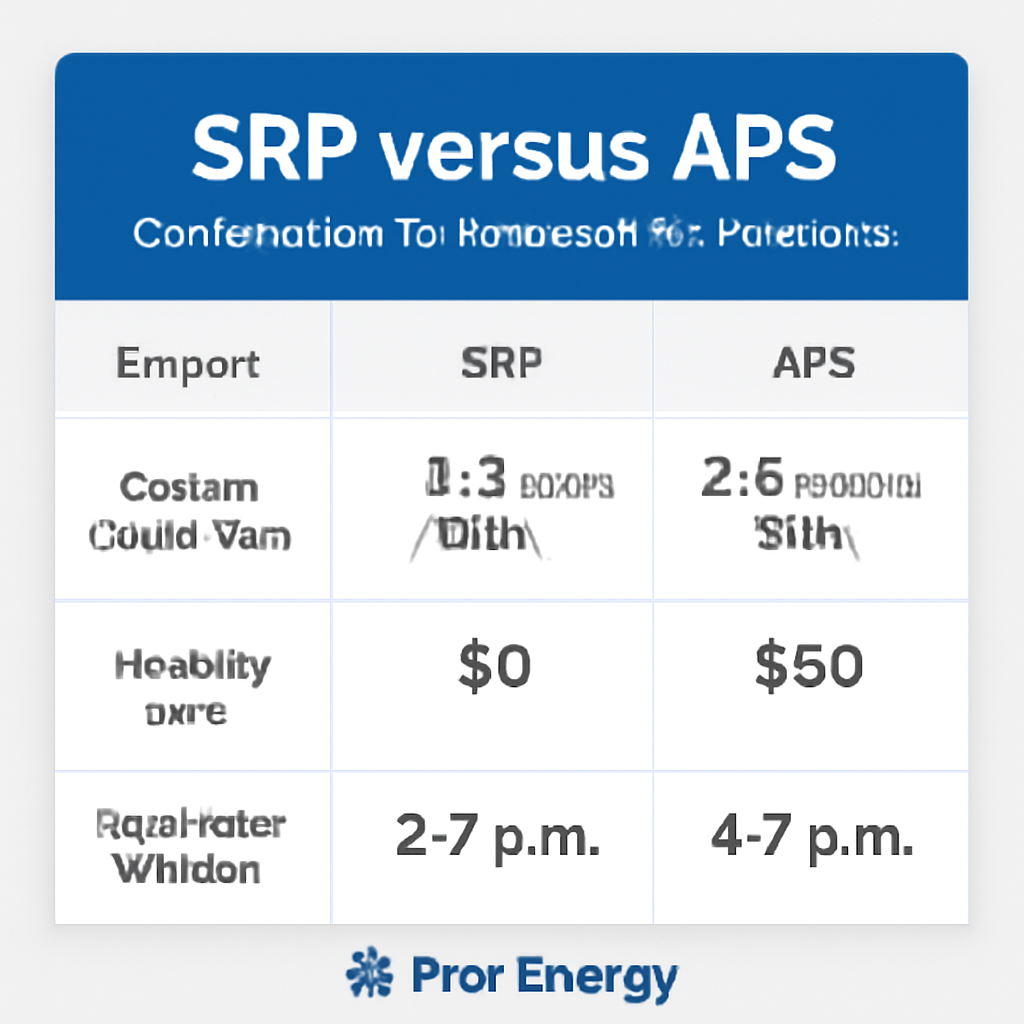
First off, SRP’s export credit sits around 2.8¢ per kWh. APS, the other big Arizona player, pays roughly 5.6¢‑7.2¢ per kWh depending on the plan year. That’s almost double, sometimes triple, the amount you’d see with SRP.
But it’s not just the cents‑per‑kWh that matter. SRP tacks on a flat $32.44 monthly grid access charge, no matter how much solar you generate. APS’s basic service fee is a modest $13‑$15 a month. Those fixed fees can chew through the modest credits you earn from SRP.
Export Credit Rate
Imagine you’ve got a 6 kW system that pumps out 800 kWh in July. With SRP, you might export 200 kWh at 2.8¢, earning about $5.60. Switch to APS and that same export could be worth $11‑$14. That extra $6‑$8 isn’t trivial; it can shave weeks off your payback period.
For a small business that runs a 24/7 refrigeration unit, the difference compounds quickly. Exporting 1,000 kWh a month on APS could bring in $70, whereas SRP would only hand you $28. That $42 gap can be the difference between a profitable solar investment and a marginal one.
Monthly Fixed Charges
SRP’s $32.44 fee doesn’t scale with system size. Whether you’ve got a 3 kW starter kit or a 10 kW roof‑top, you still pay the same amount. APS’s lower fee means you keep a larger slice of the export credit, especially when you’re just getting started.
And here’s a little trick: because SRP’s fee is fixed, the more you can reduce your export – by storing energy or shifting loads – the better your net‑metering credit looks against that fee.
Peak‑Hour Windows
Both utilities use time‑of‑use (TOU) structures, but the windows differ. SRP’s on‑peak periods are 5 a.m.–9 a.m. and 5 p.m.–9 p.m. APS’s peak is a tighter 4 p.m.–7 p.m. in summer. That means SRP customers often have to buy power at high rates in the evening after the sun sets, while APS customers have a narrower window where they’re forced to import.
What does that mean for you? If you can shift a dishwasher run or EV charging into the morning 5‑9 a.m. slot, you avoid the pricey 5‑9 p.m. on‑peak charge on SRP. APS owners get a bit more wiggle room because their peak ends earlier.
What This Means for Residential Homeowners
If you’re a typical Phoenix homeowner, the lower SRP credit pushes you toward self‑consumption. A 5 kWh battery can capture midday surplus and discharge it during the 5‑9 p.m. peak, effectively turning a 2.8¢ export credit into a avoided 22¢‑plus on‑peak charge.
Without storage, you’ll likely see the bulk of your savings come from reduced grid imports rather than export credits. That’s why we always suggest a quick “export‑to‑self‑consumption” audit before deciding on a battery size.
What This Means for Small Business Owners
For a boutique bakery or a dental office, the calculus shifts. Those businesses have predictable high‑load periods (oven use, HVAC) that line up with SRP’s evening peak. By installing a modest storage system, they can avoid buying that expensive evening power and still pocket the modest export credit for any leftover juice.
In practice, a 10 kWh battery can shave $150‑$200 off an annual bill for a small business on SRP, whereas the same battery on APS might only save $100‑$130 because the export credit is already higher.
Actionable Checklist
- Pull your latest SRP and APS rate‑schedule PDFs and note the export credit and fixed fees.
- Log hourly export data for a full week; flag any spikes during the 5‑9 a.m. and 5‑9 p.m. windows.
- Identify 2‑3 high‑energy loads you can shift into those windows (e.g., dishwasher, EV charger, pool pump).
- Run a simple ROI calc: (Avoided on‑peak cost × kWh stored) – (battery cost ÷ life years). If the number is positive, storage makes sense.
- Set a quarterly reminder to revisit the rate‑schedule – SRP tweaks the wholesale price and TOU multipliers every three months.
- Plan for the 2029 legacy‑plan sunset now; the later on‑peak window will make storage even more valuable.
Bottom line: SRP’s buyback rate is lower than APS’s, and its fixed monthly charge is higher. That combination nudges you toward self‑consumption and storage rather than hoping for generous export credits. By understanding the numbers, timing your loads, and considering a modest battery, you can turn a seemingly weak SRP rate into a solid savings strategy.
Key Factors that Influence SRP Solar Buyback Rates
When you stare at your SRP bill and see that modest credit, the first question is: why does the SRP solar buyback rate change at all? The answer lies in a handful of levers that SRP pulls every quarter. Understanding those levers lets you turn a small credit into a meaningful savings strategy.
1. Wholesale electricity price
SRP’s credit is anchored to the market price it pays other generators at the moment your panels feed the grid. When the regional wholesale price spikes in summer, the buyback rate nudges upward – but only for the kilowatt‑hours exported during that exact hour. Conversely, a low‑price week drags the rate down.
What does that mean for you? If you can spot a pattern in your export data – say a consistent surge on hot July afternoons – you’ll know when the credit is likely to be at its best.
2. Time‑of‑use (TOU) windows
SRP splits the day into “super off‑peak,” “off‑peak,” and “on‑peak” periods. Export during the 5 a.m.–9 a.m. or 5 p.m.–9 p.m. on‑peak windows fetches a higher multiplier than the midday “super off‑peak” slot.
Imagine you have a 6 kW system that pumps out 8 kWh at 2 p.m. If that energy is exported during a super off‑peak hour, the credit might be 1.8 ¢/kWh. Shift a few of those kilowatts to the 6 p.m. on‑peak window, and you could see 2.6 ¢/kWh instead – a noticeable bump for a single day.
3. Rate‑plan design
SRP offers several residential plans, each with its own export‑credit formula. Legacy plans like E‑13 keep the credit flat, while newer plans such as E‑16 and E‑28 apply separate multipliers for each TOU band. The newer plans also push the on‑peak window later into the evening, which means daytime exports often land in the lower‑value tier.
In our experience, homeowners who are still on a legacy plan often see a steadier credit, but the upcoming sunset of those plans in 2029 makes a switch inevitable. Knowing which plan you’re on helps you decide whether a battery or load‑shifting strategy will pay off sooner.
4. Fixed monthly charges
SRP tacks on a flat $32.44 grid‑access fee every month, regardless of how much solar you generate. That fee effectively eats into the credit you earn. The higher the fixed charge, the more you need to boost self‑consumption or storage to keep the overall bill low.
For a typical Phoenix household, cutting export by 50 % and using that energy at night can offset more than half of that monthly fee – a concrete reason to consider a modest 5 kWh battery.
5. Seasonal demand spikes
Summer in the desert drives on‑peak rates sky‑high, while winter evenings are relatively gentle. Because the buyback rate follows wholesale prices, you’ll notice a seasonal rhythm: higher credits in July, lower in December. Planning your battery usage around these peaks maximizes the dollar‑per‑kilowatt‑hour you save.
Picture this: you store 6 kWh on a hot July afternoon and discharge it after 6 p.m. when SRP’s on‑peak charge hits 22 ¢/kWh. You avoid paying that 22 ¢ and still collect the 2.5 ¢ export credit for any leftover juice. That double‑dip is the sweet spot every solar owner craves.
Quick checklist of influencing factors
- Current wholesale price (check SRP’s quarterly rate‑schedule PDF).
- TOU window you’re exporting in – aim for on‑peak slots.
- Your specific rate‑plan (legacy vs. E‑16/E‑28).
- Monthly fixed grid‑access charge.
- Seasonal demand trends – summer vs. winter.
By tracking these five pieces, you can predict when the SRP solar buyback rate will be generous and when it will be skinny. Then you decide: do you shift a dishwasher run, add a small battery, or simply wait for the next rate‑schedule update?
Bottom line: the buyback rate isn’t a mystery; it’s a combination of market price, timing, plan rules, fixed fees, and seasonal demand. Knowing each factor gives you the leverage to turn a few cents per kilowatt‑hour into real, measurable savings on your Arizona electric bill.
FAQ
What exactly is the SRP solar buyback rate and how does SRP calculate it?
In plain terms, the SRP solar buyback rate is the credit you get for every kilowatt‑hour (kWh) your system sends back to the grid. SRP takes the wholesale market price at the moment of export, applies a time‑of‑use multiplier (super off‑peak, off‑peak, on‑peak), and then adds any plan‑specific adjustment. The result is the cent‑per‑kWh figure you see on your bill.
How often does SRP change the buyback rate?
SRP publishes a new rate‑schedule PDF every quarter, so the buyback rate can shift four times a year. Those updates reflect changes in wholesale electricity costs, seasonal demand spikes, and any tweaks to the TOU windows. It’s worth setting a calendar reminder to download the latest PDF and compare the new credit to what you were getting before.
Does the time‑of‑use (TOU) schedule really affect the credit I receive?
Absolutely. SRP splits the day into super off‑peak, off‑peak, and on‑peak periods, and each window carries a different multiplier. Exporting during a super off‑peak hour might earn you 1.8 ¢/kWh, while the same energy exported in an on‑peak slot could be worth 2.6 ¢/kWh. By shifting high‑energy loads or adding storage, you can push more of your export into the higher‑value windows.
Can I boost my buyback earnings without installing a battery?
Yes, you can start with simple load‑shifting. Run your dishwasher, pool pump, or EV charger during midday when your panels are generating, so you keep that energy at home instead of exporting it for pennies. Also, keep an eye on the quarterly rate‑schedule – if the wholesale price spikes, even a modest export during that hour will fetch a higher credit.
How does SRP’s fixed monthly grid‑access charge impact my overall savings?
The $32.44 grid‑access fee is a flat cost you pay whether you generate a lot of solar or not. That fee effectively eats into the small buyback credit, so the more you can offset grid imports with self‑consumption or stored energy, the less the fee hurts your bottom line. Think of the fee as a baseline – every kilowatt‑hour you avoid buying at on‑peak rates is a direct offset.
What should residential homeowners consider when picking an SRP rate plan?
First, check whether you’re on a legacy plan (like E‑13) or one of the newer TOU plans (E‑16 or E‑28). Legacy plans give a steady, low credit, while the newer plans push the on‑peak window later, making daytime export less valuable but opening a bigger gap for storage. Look at your typical daily consumption patterns – if you can shift a few loads to the morning 5‑9 am window, you’ll avoid the pricey 5‑9 pm on‑peak charge.
Are there tax incentives or rebates that change the value of the buyback rate?
Yes. Arizona still offers a federal Investment Tax Credit (ITC) that can cover up to 30 % of your solar‑plus‑storage system cost, and SRP periodically runs a solar battery rebate that reduces upfront expenses. Those incentives don’t raise the buyback credit itself, but they improve the overall return on investment, making the modest 2‑3 ¢/kWh credit part of a larger savings picture.
Conclusion
So, after digging through the numbers, the SRP solar buyback rate feels like a tiny lever—but it’s the lever that can tip the whole savings equation.
If you’ve been wondering whether the credit is worth chasing, remember this: every cent you keep from an export is a cent you don’t have to pay during that pricey on‑peak window. Pair that with a modest 5 kWh battery, and you’re turning a 2‑3 ¢/kWh credit into an avoided 20‑plus ¢ charge.
What does that look like in real life? Picture a Phoenix family who shifts the dishwasher to 7 a.m., stores midday surplus, and uses it after 6 p.m. The result? Roughly $120 saved each summer, plus the peace of knowing the 2029 legacy‑plan sunset won’t catch them off guard.
Here’s a quick sanity check you can run tonight: grab your latest SRP bill, note the export credit, jot down your on‑peak rate, and ask yourself if a small battery could cover the gap. If the answer is “yes,” you’re ready to act.
We’ve walked through the how‑to, the why, and the numbers. Now it’s up to you to take the next step—whether that’s scheduling a free audit, pulling the rate‑schedule PDF, or simply noting a few load‑shifts in your planner. The SRP solar buyback rate may be modest, but with a little strategy, it can become a solid piece of your overall solar ROI puzzle.